







AI Dating Coach: Helpful Shortcut or New Way to Overthink Everything? is a question a lot of daters are asking. Usually, it starts with a screenshot: “It wrote a better reply than I could.” Then comes the quieter question: “Does that mean I am bad at dating without it?”
My honest answer is that an AI dating coach can be useful. It can help you turn a rambling profile into something clearer, soften a message that sounds too intense, or get you unstuck after dating fatigue has made every first message feel like a job application. But it can also turn one simple “Hey, how was your weekend?” into a 45 minute committee meeting with a chatbot.

Here’s the thing: AI is best used as a drafting assistant, not a mind reader, compatibility detector, or substitute for your own judgment. It can polish your words. It cannot reliably tell you whether someone is emotionally available, whether their inconsistency is harmless or breadcrumbing, or whether a relationship red flag deserves serious attention.
The goal is not to make every message perfect. The goal is to make it easier to show up as yourself.
Table of Contents
What you will find here
- What an AI dating coach actually does
- When AI assistance is genuinely useful
- When it becomes another source of anxiety
- A practical way to use it without losing your voice
- Privacy and safety boundaries
- Common questions about AI assisted dating
Key Takeaways
The short version
- Use AI for low stakes editing, profile clarity, and first draft ideas.
- Do not use it as the final authority on attraction, compatibility, intent, or safety.
- If you are generating more than a few versions of one message, the tool is probably feeding overthinking rather than reducing it.
- Share the minimum context needed. Dating details are personal, and you do not need to paste someone’s full profile, private messages, workplace, or location into a chatbot.
How it plays out in practice
People tend to land at two extremes. One person uses AI to turn “I don’t know what to say” into a warm, specific opening line and actually starts enjoying swipe culture again. Another spends so long asking for “a slightly flirtier but not too eager version” that the match has already moved on.
The difference was not intelligence, confidence, or match percentage. It was whether they used the tool to move forward or to avoid the vulnerable moment of simply sending the message.
A simple decision rule
Ask one question before you open the tool: Am I looking for help expressing what I already mean, or am I asking it to decide what I should feel and do?
The first is usually a reasonable use. The second is where to pause.
What an AI Dating Coach Actually Does
It is usually a writing tool with relationship opinions attached
An AI dating coach is generally a generative AI tool that helps you create or revise dating profiles, opening lines, follow ups, replies, photo captions, and sometimes broader dating strategy. Some tools also claim to analyze conversations or identify patterns in a person’s behavior.
That last category deserves skepticism. A chatbot sees a limited slice of a situation. It does not see the pause before someone answers, the warmth in their voice, your body language on a date, or the pattern that has unfolded across six weeks. It may sound certain anyway (which is not the same thing as being right).
The best uses are narrow and practical
It helps to separate AI assisted matchmaking and writing help into two buckets: low stakes drafting and high stakes judgment.
| Dating task | AI can be helpful when | Avoid relying on it when |
|---|---|---|
| Profile rewrite | Your profile is vague, repetitive, or overly formal | It invents hobbies, values, or a personality you do not recognize |
| First message | You need a few specific conversation starters | You need it to manufacture interest you do not actually feel |
| Reply tone check | You worry your message sounds cold, defensive, or too intense | You are seeking permission to ignore your own discomfort |
| Follow up message | You want a clear, respectful check in | The other person has repeatedly ignored your boundaries |
| Date decision | You want questions to reflect on | You want a verdict on whether someone is safe or right for you |
You know, the tool is often better at editing tone than inventing personality. Give it your rough message and ask, “Make this 15% clearer while keeping it casual and kind.” That is very different from asking, “Write something irresistible.” One keeps you in the driver’s seat. The other can make you sound like a stranger wearing your name tag.
Better text is not always a better outcome
A polished message is not automatically a good message. Three outcomes matter more:
- Did the reply sound like you?
- Did it make the conversation easier and more comfortable?
- Did sending it reduce your anxiety instead of creating another cycle of checking, revising, and waiting?
A person who is a good fit will not require you to become a copywriter with a minor in emotional chess. If connection only survives when every sentence is optimized, that tells you something.
When AI Helps and When It Feeds Overthinking
It can lower the barrier to action
For people who freeze before messaging someone, AI can offer a useful bridge. This can be especially true for introverts, people returning to dating after a breakup, or anyone dealing with approach anxiety. If that is familiar, you may also relate to approach anxiety and the fear of being unwanted in modern dating.
A good use might look like this: you notice a match loves hiking and old movies. You write, “Your profile made me realize I need a better movie recommendation.” AI helps you turn that into three natural variations. You choose the one that sounds most like you, personalize it, and send it.
That is a shortcut through hesitation, not a replacement for connection.
It can create analysis paralysis
Here’s the thing, many clients do not need 20 possible replies. They need one decent reply and the willingness to tolerate uncertainty.
AI can make rumination feel productive because every revision looks like progress. You may be refining punctuation while avoiding the harder truth: you cannot control whether another person replies, likes you, or has the emotional availability for a real relationship.
Fair warning: there is limited clear evidence on whether AI dating coaches improve actual dating outcomes over time. A tool may make a message sound smoother without improving conversation quality, relationship satisfaction, or your sense of calm. Treat your own experience as useful data.
Dating apps already invite optimization
Dating apps encourage sorting, comparing, and second guessing. AI can intensify that tendency by giving you one more score, prediction, or supposedly strategic answer to chase. It is worth remembering why dating apps create matches but struggle to create real connection: a match is not intimacy, and a clever opener is not chemistry.
The U.S. Surgeon General has warned that emotionally intense online interaction can affect well being, particularly for younger people. While that guidance is not specifically about AI dating coaches, it is a useful reminder that more screen time and more emotional monitoring do not automatically make us feel better. Read the Surgeon General’s discussion of social media and mental health with that broader context in mind.
A Simple Workflow That Keeps You Human
Start with your own rough draft
Write what you would normally say before asking AI to touch it. Yes, even if it is clumsy. Especially if it is clumsy.
Your imperfect original gives the tool something real to preserve: your humor, vocabulary, level of directness, and actual interest. Without that starting point, AI tends to produce polished beige wallpaper: technically pleasant, impossible to remember.
Give one clear instruction and limit the options
Use a focused request rather than “Fix this.” For example:
“Keep my casual tone. Make this message clearer and a little warmer. Give me three options, each under 35 words. Do not add compliments I did not mean.”
Then choose, revise, and stop. A three version limit helps because endless options make it easier to chase the imaginary perfect response.
- Write your real draft.
- Ask for up to three revisions.
- Select the closest version.
- Add one true, personal detail.
- Send it within 10 minutes.
If you cannot send it after that, the obstacle is probably not wording anymore. It may be fear of rejection, uncertainty about your standards, or old dating fatigue asking for a disguise.
Use the comfort test after you send
After a few AI assisted conversations, check in with yourself. Not your reply rate. Yourself.
| If you notice this | It may mean | What to do next |
|---|---|---|
| You feel calmer and more direct | The tool is reducing friction | Keep using it for limited drafting tasks |
| You reread chats compulsively | The tool is feeding reassurance seeking | Take a one week break from AI advice |
| Your messages sound unusually polished | Your voice may be getting diluted | Return to rough drafts and lighter edits |
| You ask AI to interpret every delay | You are outsourcing emotional judgment | Talk with a trusted person or reflect offline |
| You feel less sure of your own choices | Dependency may be building | Restrict use to profile and grammar edits |
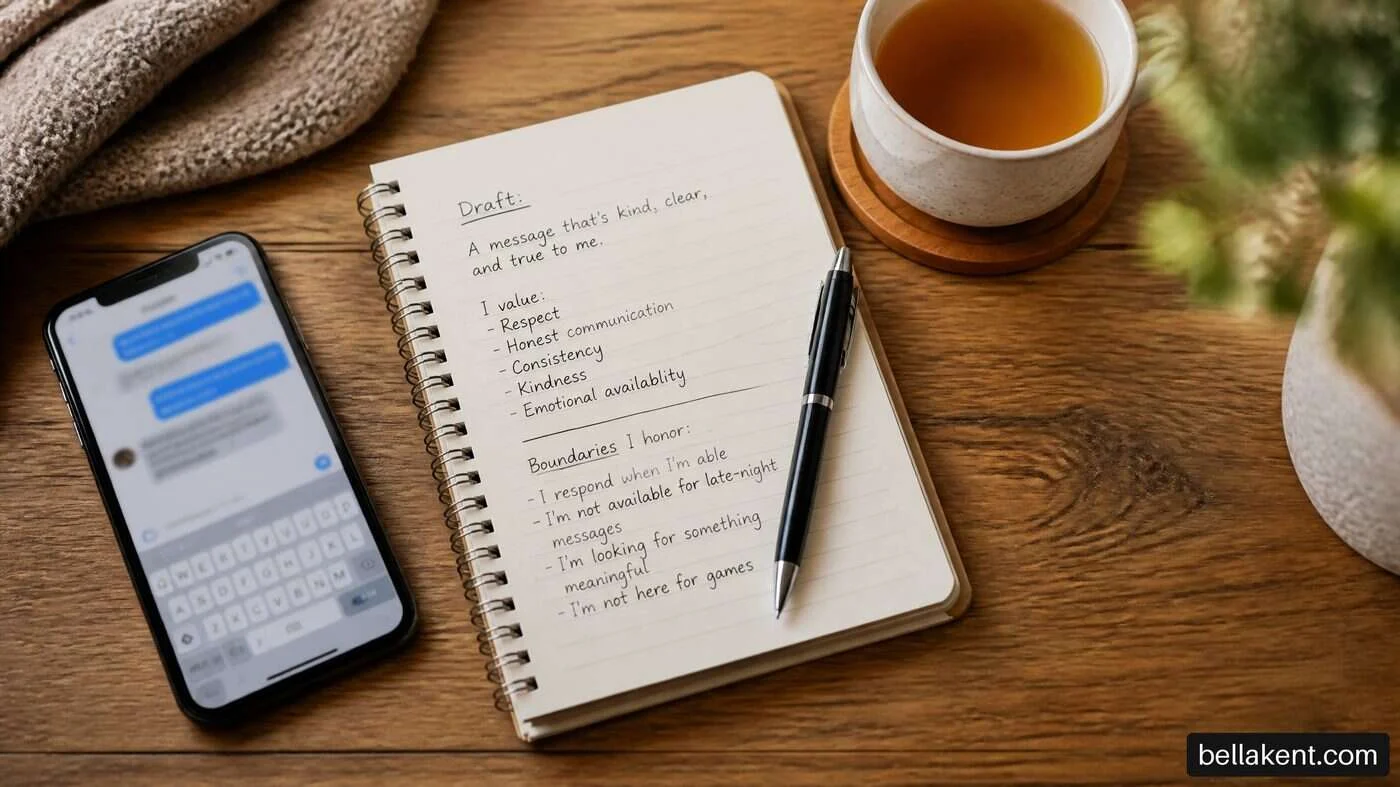
Privacy, Authenticity, and the Boundaries AI Cannot Hold
Share less than you think you need to
Dating conversations include sensitive information: names, photos, sexual history, conflict details, health information, workplaces, neighborhoods, and vulnerable disclosures. You do not need to hand all of that over to get help drafting one text.
The Federal Trade Commission’s basic data minimization principle is sensible here: share only what is necessary for the task. Before using a service, read its data practices and consider whether it needs the details you are about to provide. OpenAI’s privacy policy is one example of the kind of disclosure worth reviewing before you paste personal material into any AI service.
A safer prompt would be: “A person I have been on two dates with canceled twice. Help me write a calm message asking whether they still want to make plans.” You do not need to include their name, employer, address, screenshots, or identifying details.
Do not use AI to impersonate emotional spontaneity
Is it deceptive to get editing help? Not necessarily. Most of us ask friends to read a text sometimes.
But there is a line. If AI is writing intimate declarations, apologies, or vulnerable conversations that do not reflect what you believe, you are creating a connection with borrowed emotional language. That tends to fall apart when real life requires you to speak without a script.
The guidance on safe and responsible AI use is also a useful reminder that tools should not be used to deceive or harm people. In dating terms, do not use AI to manipulate, pressure, impersonate, or conceal essential truths.
Safety calls require human judgment
No chatbot should make the call on coercion, stalking, harassment, threats, repeated boundary violations, or whether you are physically safe meeting someone. It can miss context, reflect biased assumptions, or give an overconfident answer based on too little information.
The NIST AI Risk Management Framework highlights risks such as unreliable outputs, lack of transparency, and overreliance. Those are not abstract tech concerns when you are deciding whether to meet a person who is pushing past your “no.” The NIST framework for managing AI risks is useful because it puts the responsibility back where it belongs: evaluate the tool’s limits rather than treating it like an authority.
When safety is involved, talk to someone you trust, use platform reporting tools when appropriate, and contact local emergency services if you are in immediate danger.
Using AI Without Outsourcing Your Dating Life
Let it support your standards, not lower them
Some people use an AI dating coach to rationalize behavior they already know does not feel good. “Maybe I am overreacting that they only text after midnight.” “Maybe the AI says I should give them another chance.”
No tool can define your boundaries for you. If you are unsure where flexibility ends and self abandonment begins, read about standards vs settling in dating. A good match does not require an algorithm to talk you into accepting less than you need.
Watch for bias dressed up as confidence
AI advice can reflect stereotypes about gender, culture, attachment, attractiveness, and dating roles. If a tool tells you that one person “should” pursue, pay, wait, forgive, or explain based on a broad category, be suspicious.
A better question is not, “What do people like them want?” It is, “What have they consistently shown me, and how do I feel in response?” That is slower, but it is also more grounded.
Know when not to open the app
Avoid AI dating advice when you are:
- Panicking after a difficult text exchange
- Trying to decide whether a serious boundary violation matters
- Tempted to send a message designed to provoke jealousy or guilt
- Writing a breakup message you do not actually agree with
- Seeking certainty about someone’s intentions from limited evidence
Sometimes the healthiest move is to put the phone down, make tea, call a friend, and let your nervous system settle before you decide what you think. Not glamorous. Very effective.
FAQ: Common AI Dating Coach Questions
What does an AI dating coach actually do, and can it help with messages?
It can help draft first messages, follow ups, replies, profile descriptions, and tone adjustments. It is most useful when you have an intention but need help expressing it clearly. For instance, it can turn “I had fun, want to do it again?” into a version that feels warmer without becoming overly intense.
It cannot reliably determine whether a person likes you, why they have gone quiet, or whether you are compatible. Those are human questions with incomplete information, not math problems waiting for the right wording.
How do I keep AI generated messages from sounding fake?
Start with your own draft, ask for no more than three options, and add one detail only you would say. Keep your usual texting style. If you use short sentences, do not suddenly send a beautifully structured paragraph with three semicolons (unless that is truly your thing, in which case, carry on).
Before sending, ask: “Would I be comfortable saying this out loud on a date?” If the answer is no, rewrite it in your own words.
Is it bad to rely on AI for dating advice or anxiety?
Not automatically. AI can reduce the friction of sending a message when anxiety has you stuck. It becomes unhelpful when you need its approval before every choice, ask it to interpret every delayed reply, or feel less capable without it.
The healthiest use is occasional and specific. Use it for wording, not reassurance. If dating anxiety keeps repeating, self awareness and support will usually do more for you than a better prompt.
How much of my dating situation should I tell an AI?
Only the minimum needed to get useful help. Remove names, locations, jobs, personal photos, health details, and identifying information about anyone involved. Do not paste private messages from a partner or date if a summarized version will do.
If a tool’s privacy terms are unclear, that is your answer: do not hand it your most intimate material.
Can AI help me decide who to message or date?
It can help you create reflection questions, such as “Do I feel relaxed around this person?” or “Have their actions matched their words?” But it should not choose for you.
Use your lived experience. Notice consistency, kindness, boundaries, attraction, values, and how you feel after spending time together. A chatbot may organize your thoughts, but it cannot inhabit your relationship.
The Bottom Line
Use the shortcut, skip the spiral
None of this is anti technology. It is anti pretending that technology can remove the uncertainty that makes dating feel vulnerable in the first place.
Use an AI dating coach when it helps you say what you mean with more ease. Skip it when it turns dating into a performance review of every comma, delay, and match percentage. The right person is not looking for the most optimized version of you. They are looking for a real one.
Try one small experiment this week: use AI for a single draft, choose within 10 minutes, personalize it, and send it. Then pay attention to whether you feel more like yourself afterward. That is the metric to trust.
Sources and References
Primary guidance consulted
- National Institute of Standards and Technology, AI Risk Management Framework
- U.S. Surgeon General, Social Media and Youth Mental Health
- OpenAI Privacy Policy
- OpenAI Usage Policies
Related: ai relationship advice the things couples wish they.