

Okay, let’s be real: AI Dating Advice: What Actually Helps When Modern Dating Feels Exhausting is not about finding a robot that can decode every “haha” in a text message. If only. It is about using AI for the small, draining parts of dating—writing, editing, sorting your thoughts—without handing over your judgment, privacy, or personality.
Across dating apps, ghosting, post-divorce dating, situationships, and the occasional “Why did I agree to meet him at a loud sports bar?” story, one pattern shows up constantly: dating exhaustion is often less about one bad match and more about the constant decision-making. Swipe. Reply. Interpret. Wonder. Repeat.
AI can reduce some of that mental load. But it works best as a drafting partner and a pause button—not as a substitute for a therapist, a detective, or an authority on whether someone secretly likes you.
The rule: Use AI for wording and reflection. Do not use it to pretend, pressure, diagnose, or manufacture compatibility.
Table of Contents
What this article covers
- What AI can genuinely make easier on dating apps
- A simple workflow for using it without sounding robotic
- The privacy, overthinking, and confirmation-bias traps to avoid
- When a trusted person, an honest conversation, or professional support matters more than another prompt
A quick note before we begin
Most dating advice is too prescriptive. Your communication style, love languages, relationship history, and tolerance for swipe culture are personal. Use the ideas here as flexible tools—not rules you must follow perfectly.
Key Takeaways
What AI is actually good for
AI can help you write a clearer profile, brainstorm a first message, edit an anxious text before sending it, and identify the questions you want to ask on a date. It is especially useful when you are tired enough to write “hey” for the tenth time and call it a personality.
What AI cannot do for you
AI cannot tell you whether a stranger is emotionally available, whether a red flag is truly a pattern, or whether the chemistry will be there in person. It can organize evidence; it cannot live your relationship for you.
The healthiest way to measure success
If AI use leaves you feeling calmer, more selective, and more like yourself, it may be helping. If it makes you send more messages, analyze every comma, or tolerate people you do not even enjoy, it is adding to the problem.
Where AI Dating Advice Actually Helps
Profile writing: clarity beats perfection
Many people overthink their dating profiles. They try to sound clever, effortless, adventurous, emotionally evolved, and somehow casually fluent in three languages before breakfast. The result often reads like a corporate bio with a photo of a golden retriever.
AI can help you turn scattered facts into a profile with a point of view. Give it a few real details—your typical Sunday, what you are looking forward to, an opinion you genuinely have—and ask it to create several options in your voice.
Try a prompt like this:
“Help me write three dating-profile answers using a warm, witty, down-to-earth voice. Keep these details: I love early morning farmers’ markets, I am learning to cook Thai food, and I want a relationship with someone kind and emotionally direct. Avoid clichés and do not make me sound overly polished.”
The goal is not to create the most optimized profile. It is to make it easier for the right person to recognize you. Personality matters too—not just polished photos and perfect banter.
Message drafting: use AI as a rehearsal room
You know what’s frustrating? You finally match with someone promising, then spend twenty minutes trying to write a message that sounds interested but not too interested. That is where AI can be handy.
Ask it for a few conversational openings based on something specific in their profile. Then choose one, rewrite it, and send it before you have time to turn a normal hello into a dissertation.
| AI can help with | Your job still matters because |
|---|---|
| Turning a profile detail into a question | Curiosity has to be real, not performative |
| Editing a message for warmth and clarity | The final message should sound like you |
| Offering shorter and longer versions | You decide the appropriate level of interest |
| Softening an overly reactive draft | You decide whether the conversation is worth continuing |
An AI-polished first message can be technically charming and still ring false—something like “I’m intrigued by your philosophical relationship with brunch” that nobody would actually say out loud. A simple rewrite like “You had me at breakfast burritos. What’s your current favorite spot?” works much better. Human. Easy to answer.
Conversation triage: reduce decision fatigue, not standards
Dating apps can create a weird illusion that every match deserves an equally thorough review. They do not. Decision fatigue is real; the American Psychological Association explains that repeated choices can wear down the quality of later decisions in its overview of decision fatigue and depleted judgment.
AI can help you create a simple screen for your own priorities. For example, you can ask it to turn your values into three questions to consider before investing more energy:
- Does this person show consistent interest, rather than breadcrumbing?
- Do I feel comfortable and curious after talking to them?
- Are their relationship goals compatible with mine right now?
Notice what this does not ask: “Can AI tell me if they are my soulmate?” That is not triage. That is outsourcing your nervous system.
If apps already have you questioning why dating apps struggle to create real connection, use AI to narrow your attention—not to convince yourself that more swiping is the answer.
A Low-Effort Workflow That Preserves Your Voice
Step 1: Start with a small, truthful input
Fair warning: more personal information does not automatically produce better advice. In fact, it can create a privacy mess and invite the AI to overinterpret details that may not matter.
Use a short summary instead of pasting an entire chat history. Replace names, workplaces, locations, and identifying details. Keep private photos, phone numbers, addresses, financial information, health information, and intimate images out of the conversation entirely.
The U.S. National Institute of Standards and Technology emphasizes privacy, reliability, safety, and human oversight in its AI Risk Management Framework. For dating, that translates into a very ordinary but useful habit: share the minimum needed to get help.
Step 2: Ask for options, not a verdict
The best AI request is usually specific and modest. Ask for alternatives, questions, or edits. Avoid asking it to make declarations about someone else’s motives.
| Better request | Request to avoid | Why it matters |
|---|---|---|
| “Give me three calm ways to ask what they are looking for.” | “Do they want a relationship with me?” | Intent needs a real conversation |
| “Help me shorten this bio while keeping my humor.” | “Make me irresistible.” | Attraction cannot be engineered into certainty |
| “What questions could I ask myself after this date?” | “Was this person manipulating me?” | AI lacks the full context and stakes |
| “Edit this message so it is direct, not harsh.” | “Tell me what this text really means.” | Text interpretation is often ambiguous |
Okay, let’s be real—when you are anxious, a confident answer can feel soothing even when it is wildly wrong. That is why you want choices, not a digital fortune cookie pretending to be a relationship coach.
Step 3: Do a human edit before you send
Read the suggestion aloud. Would you actually say it to a friend? Does it include a phrase you would never use? Is it trying too hard to be playful, seductive, detached, or profound?
Before you hit send, check three things:
- Accuracy: Is every detail true?
- Voice: Does this sound like me on a good day?
- Intention: Am I inviting a conversation, or trying to control the outcome?
That final question is the big one. A message can be polished and still be emotionally manipulative. “I respect your boundaries, but I need you to explain why you disappeared” may sound mature, for example, while still demanding emotional labor from someone who has already stepped away.
When AI Makes Dating Worse
It can amplify confirmation bias
If you ask, “Is he pulling away because he is afraid of intimacy?” you have already built the conclusion into the question. AI may generate a plausible explanation because plausible explanations are its specialty. That does not make the explanation true.
Picture someone sharing a few texts from a person they’d dated twice, where the replies had slowed down. An AI tool might offer a tidy interpretation about avoidant attachment. But the simpler explanation is often just as possible: waning interest. The calmer move is to stop trying to diagnose the other person and send one clear message instead: “I’ve enjoyed getting to know you. Are you interested in making plans again?”
That is dating maturity. Not decoding. Asking.
It can create a polished version of you that cannot last
When every bio answer, first message, and flirty reply is generated, the date eventually meets a person who sounds different from the chat. That gap can feel awkward for both people.
This happens to people who use AI to become ultra-confident, ultra-witty, and strangely fond of semicolons. Then they sit across from a date feeling like they have to perform a role they never auditioned for.
Authenticity is not dumping your entire emotional autobiography in message three. It is letting your actual rhythm show up. A little nervousness is okay. A slightly imperfect joke is okay. A normal human sentence is more than okay.
It can turn reflection into rumination
AI can be useful after a bad date if you use it to sort your thoughts: “What did I like, what felt off, and what do I want to do differently next time?” It becomes less useful when you keep asking the same question in new forms until you get the answer you wanted.
The U.S. Surgeon General’s work on loneliness and social connection is a useful reminder that dating burnout is not trivial. When connection feels scarce, every match can start to feel disproportionately important. That is exactly when an AI answer may feel more certain than it deserves to.
If you notice yourself feeding it screenshots at midnight, asking whether a two-word text proves rejection, step away. Text a friend. Go to sleep. The answer will rarely improve at 12:47 a.m.
Protect Your Privacy and Your Judgment
Use data minimization with dating details
Dating information is sensitive because it can contain private conversations, personal photos, location clues, sexual history, family information, and vulnerable moments after a breakup. Even when a tool feels casual, treat what you type as information you would not want casually forwarded around.
Keep the context general whenever possible:
- Replace names with “the person I went on two dates with.”
- Summarize messages instead of uploading full screenshots.
- Remove workplace names, hometowns, children’s names, and specific locations.
- Never share intimate photos or identifying account details.
Watch for false certainty and persuasive language
AI can sound calm, specific, and incredibly sure of itself. That style can make weak advice feel strong. The NIST AI risk-management playbook emphasizes ongoing monitoring and human oversight. In plain dating language: check whether the tool is improving your real life, not just producing impressive paragraphs.
For two weeks, track only a few outcomes:
| Check-in question | A healthy sign | A warning sign |
|---|---|---|
| How do I feel after using AI? | Clearer and less stressed | More anxious or compulsive |
| What happens to my messages? | Shorter, warmer, more natural | Overwritten and generic |
| What happens to my standards? | More selective about effort and compatibility | Saying yes to everyone for “practice” |
| What happens after dates? | I can reflect and move on | I obsessively seek a verdict |
Do not use AI to avoid a necessary conversation
Some situations need actual words with the actual person. If you need clarity about exclusivity, boundaries, feelings, sexual health, money, conflict, or a recurring hurt, no amount of analysis replaces a direct conversation.
And if dating anxiety is making you feel panicked, unsafe, unable to function, or stuck in repeated painful patterns, professional support can be much more helpful than another round of automated reassurance. AI can help you prepare what to say in therapy or to a partner. It should not replace either.
If fear is the part keeping you frozen, this guide on approach anxiety and fear of being unwanted may help you separate “I need a better message” from “I am terrified of being seen.” Those are very different problems, and they deserve different kinds of care.
The Human-First Decision Framework
Use AI when the task is practical
Use it when you need help with structure, language, or reflection. These are low-stakes tasks where you remain clearly in charge.
- Draft a profile answer from real details.
- Edit a message for brevity and warmth.
- Brainstorm date questions that fit your values.
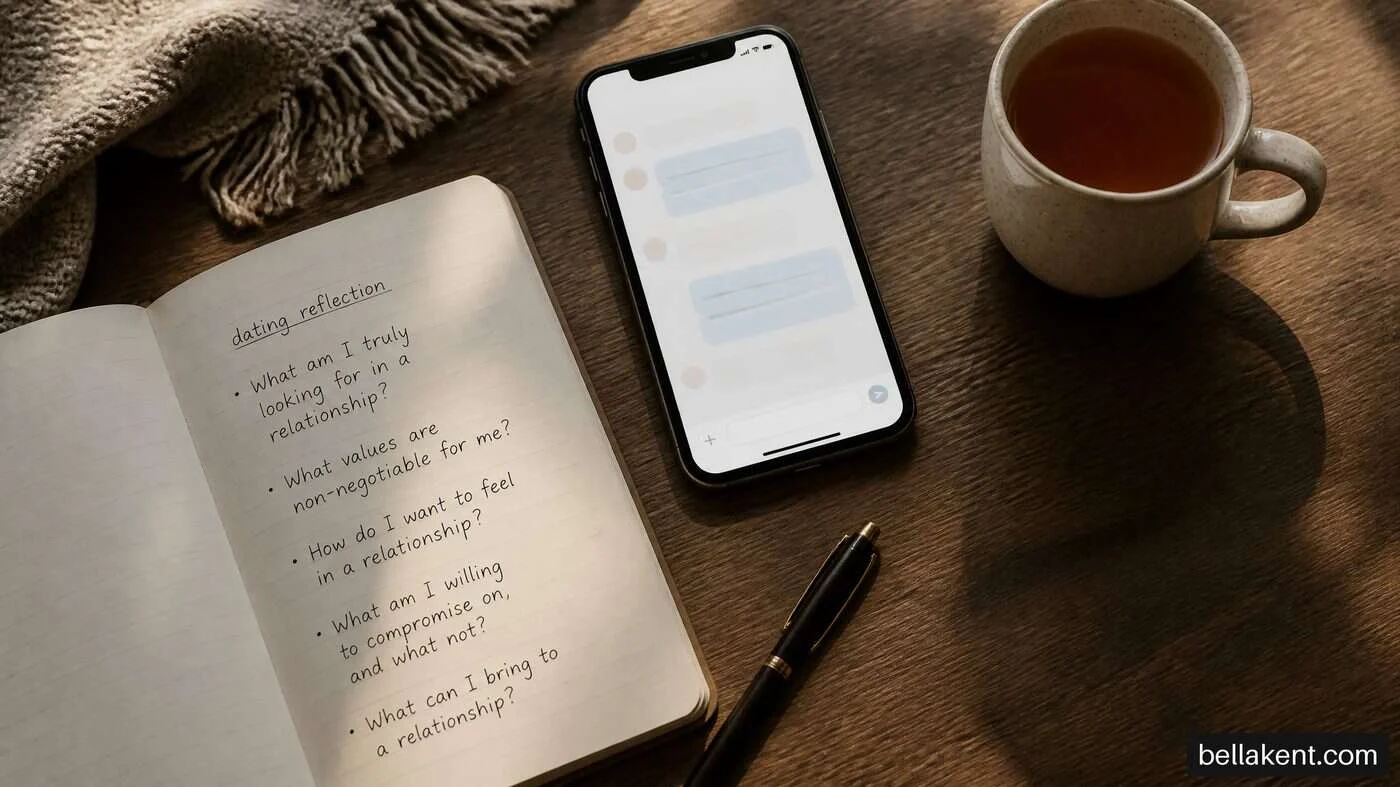
- Make a post-date reflection list.
- Practice a calm boundary statement before sending it.
Choose human conversation when the stakes are relational
Talk directly to the person when the question involves their intentions, feelings, availability, behavior, or consent. Talk to a trusted friend, coach, or therapist when the pattern touches your well-being, self-worth, safety, or repeated relationship pain.
Try this question: “Do I need better wording—or do I need more information, a boundary, or support?”
That one question can save you hours of overanalysis.
Let outcomes—not convenience—be the test
Convenience is not the same as progress. AI may help you send more messages, but more messages are not automatically better dating. The useful outcome is not volume. It is a dating process that leaves room for discernment, rest, and actual connection.
If you are trying to rebuild a steadier relationship with dating itself, read about how to stay hopeful when dating feels exhausting. Hope does not mean forcing optimism. It means choosing a pace that does not drain you dry.
FAQ: AI Dating Advice When You’re Burned Out
Can AI help me write a better dating profile?
Yes—especially if you already know the raw material but cannot organize it. Give AI real facts, ask for several versions, and keep the one that sounds most like you. Avoid profiles built from generic traits such as “partner in crime,” “fluent in sarcasm,” or “looking for someone who can keep up.” Those lines are not evil; they are just so common that they tell a potential match very little.
Is it okay to use AI to answer dating-app prompts or rewrite messages?
It is okay to use AI as an editor or brainstorming partner. It’s best not to let it write your entire personality for you. Use it to get unstuck, then make the final wording yours. If you would feel embarrassed admitting you used the exact message, it probably needs a human rewrite.
Can AI tell me which matches are worth responding to?
It can help you build your own filtering criteria, but it cannot reliably judge compatibility from a profile or a few messages. Use it to clarify your priorities—relationship goals, communication style, lifestyle fit, dealbreakers—not to assign strangers a score or predict their intentions.
What should I never paste into an AI chatbot about my dating life?
Do not paste identifying information, private photos, intimate images, exact locations, financial details, passwords, children’s information, medical information, or full unedited message histories. Summarize instead. The more sensitive the situation, the more you should protect the people involved—including yourself.
Sources and References
Guidance used in this article
- National Institute of Standards and Technology
- NIST AI Risk Management Framework Playbook
- U.S. Surgeon General
- American Psychological Association
A final word from one dating coach to another tired human
AI can help you find a sentence. It cannot tell you what you deserve, choose your boundaries, or create mutual effort where none exists.
Use it to make dating lighter, not to make yourself smaller. Then put the phone down, let someone show you who they are, and trust that the most meaningful information usually arrives in real conversation—not in a perfectly optimized reply.