

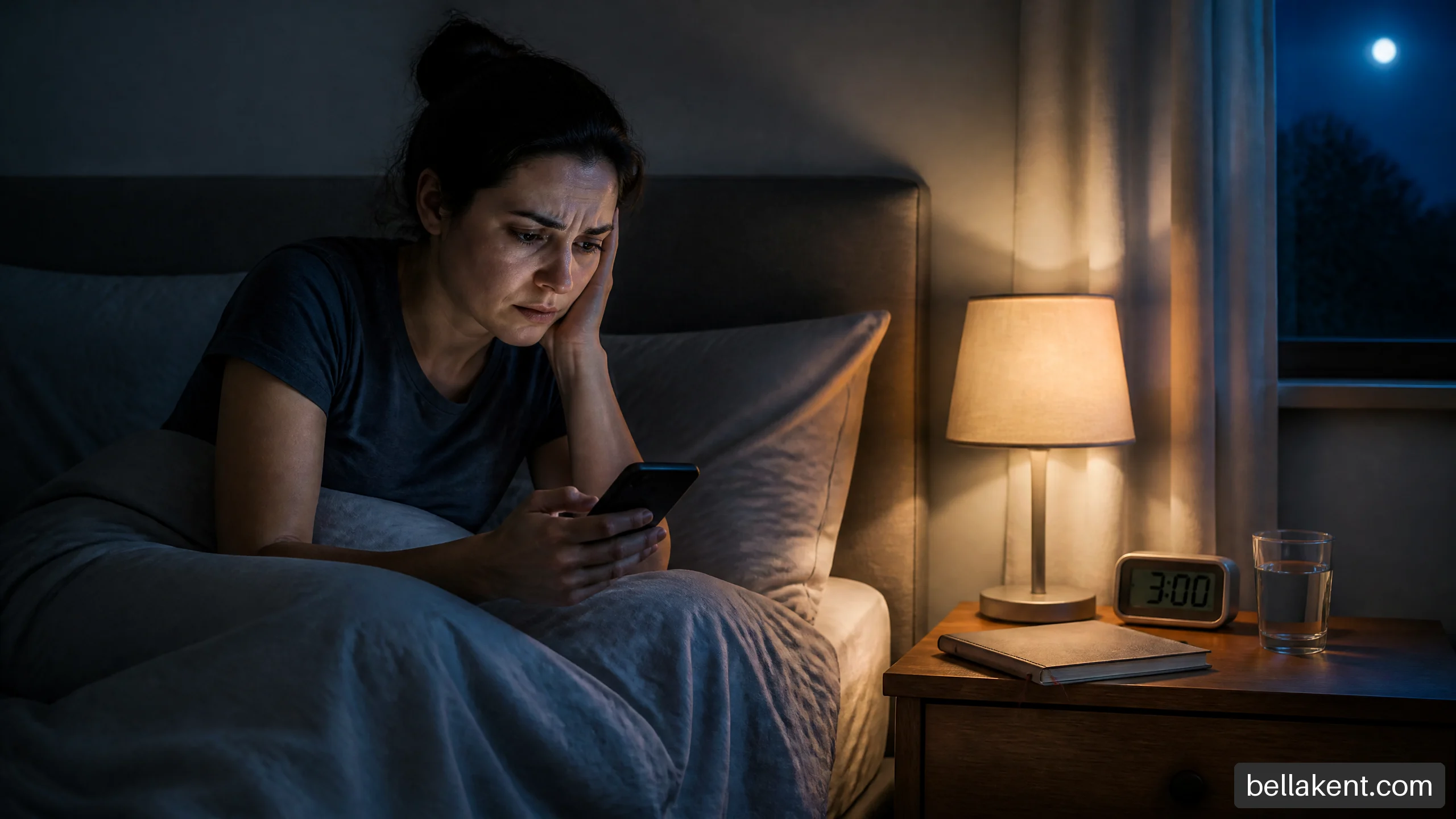
I have sat with many clients who start a session with some version of this: “I reread the text thread at 3 a.m., searched five articles about emotional unavailability, and now I think my relationship is doomed.” If that sounds familiar, you are not ridiculous, needy, or secretly psychic. You may simply be caught in the 3 A.m. Relationship Anxiety Google Spiral: The Difference Between a Real Warning Sign and an Anxious Spiral.
At 3 a.m., your brain can become a smoke detector with a low battery: loud, insistent, and not always responding to an actual fire. The goal is not to dismiss every uneasy feeling. It is to separate behavioral evidence from fear-driven interpretation before you send a breakup text, demand reassurance, or make a detective board out of your partner’s Instagram likes.
Start Here: What to Remember Tonight
Key Takeaways
• A real warning sign is usually based on observable behavior, especially behavior that repeats, escalates, violates boundaries, or makes you feel unsafe.
• An anxious spiral tends to begin with uncertainty, then grows through rereading, checking, Googling, imagining, and trying to get total certainty.
• Sleep loss can make a concern feel urgent and conclusive. The Sleep Foundation’s overview of sleep deprivation notes that insufficient sleep can affect attention, judgment, and emotional regulation.
• Do not make major relationship decisions while emotionally flooded, unless your immediate safety is at risk.
• In the morning, evaluate the concern using facts, patterns, impact, and a direct conversation when it is safe and appropriate.
Table of Contents
- Why relationship fears get louder at 3 a.m.
- How to tell evidence from interpretation
- The difference between seeking certainty and seeking safety
- A morning-after triage plan
- Frequently asked questions
- Sources and next steps
Why 3 A.m. Makes a Small Doubt Feel Like a Verdict
Your tired brain mistakes urgency for truth
Late at night, there are fewer distractions, less emotional bandwidth, and usually no helpful context. You are alone with a glowing screen, a vague feeling, and a brain that has decided one delayed reply is an entire documentary series called They Never Loved You: The Evidence.
Sleep disruption does not invent every concern, but it can turn the volume up on one. Anxiety and poor sleep can also reinforce each other: worry delays sleep, less sleep reduces coping capacity, and the next worry arrives with a megaphone. That is why I encourage a simple rule: feelings are allowed tonight; final conclusions can wait until morning.
The reassurance loop is sneaky
Googling “signs my partner is losing interest” may calm you for five minutes. Checking their location, reopening a text conversation, or asking “Are we okay?” for the fourth time may offer another tiny hit of relief. Then doubt returns, often stronger.
This is reassurance-seeking. It is not a character flaw. It is anxiety trying to reduce uncertainty as fast as possible. But repetitive reassurance can maintain anxiety rather than resolve it, which is why the American Psychological Association’s anxiety resources are useful context for understanding why relief can become a loop.
In my office, I often ask: “Did that search give you information, or did it ask the internet to guarantee you will never be hurt?” The first can be useful. The second is a job no search result can do.
Attachment anxiety can be real without being the whole story
If you have attachment anxiety, distance can feel dangerous. A partner saying, “I’m tired, can we talk tomorrow?” may land in your nervous system as, “They are pulling away forever.” That reaction deserves compassion.
Still, internal triggers and external problems can coexist. A person can have a strong fear of abandonment and be with someone who avoids accountability. The task is not to blame yourself for having anxiety. The task is to ask whether the relationship behavior supports the alarm.
Learning more about emotional regulation in relationships can help you pause without silencing yourself.
A Real Warning Sign Has Evidence You Can Point To
Separate facts from the story your fear adds
Here is the distinction I want you to practice at 3 a.m.: a fact is something a camera, calendar, screenshot, or third party could reasonably verify. An interpretation is the meaning your anxious brain assigns to that fact.
| What happened | Observable fact | Possible anxious interpretation | Better next question |
|---|---|---|---|
| They replied six hours later | A reply came six hours after your message | “They are losing interest” | Was this unusual, and did they explain they were busy? |
| They canceled plans | They canceled one plan on Friday | “I am not a priority” | Is this a repeated pattern, and do they reschedule? |
| They became defensive | Their voice rose during a disagreement | “They are emotionally abusive” | Did they insult, threaten, intimidate, or refuse repair? |
| They hid a message | You saw them turn their phone away once | “They are cheating” | Is there a broader pattern of secrecy, lying, or broken agreements? |
The middle column is where clarity lives. You do not need to pretend you feel fine. You simply need to stop treating a prediction as proof.
Use the pattern, impact, and repair rule
A single uncomfortable incident may deserve a conversation. A repeated pattern deserves closer attention. I use a practical three-part filter with clients:
- Pattern: Has this happened more than once, especially after you raised it?
- Impact: Does it regularly leave you confused, diminished, afraid, isolated, or unable to meet your basic needs?
- Repair: When you bring it up, does your partner listen, take responsibility, and make a meaningful change?
| Concern level | What it often looks like | Best next step |
|---|---|---|
| Normal uncertainty | One-off delay, misunderstanding, awkward conflict, different preferences | Sleep, note the facts, discuss calmly later |
| Relationship issue to address | Repeated disappointment, poor follow-through, recurring mismatch in needs | Have a specific daytime conversation and set a boundary |
| Serious warning sign | Repeated lying, humiliation, intimidation, coercion, isolation, threats | Prioritize support and safety planning |
A relationship does not need to be perfect to be healthy. People forget, get stressed, and occasionally say clumsy things. What matters is the pattern and what happens after the rupture. Does repair happen? Or do you get blamed for noticing the harm?
Some behaviors should never be filed under “just my anxiety”
Please do not use this article to talk yourself out of a safety concern. The National Domestic Violence Hotline’s signs of abuse include behaviors such as coercion, intimidation, isolation, and control. Those are not simply communication quirks or attachment-style differences.
Pay attention if a partner repeatedly:
• Threatens you, your children, pets, immigration status, housing, finances, or reputation
• Controls where you go, who you see, what you wear, or access to money and transportation
• Humiliates you, calls you names, or turns every concern into proof that you are “crazy”
• Punishes you for setting boundaries or pressures you into sex, substances, spending, or secrecy
• Monitors your devices, accounts, location, or communications without consent
If you are afraid of your partner’s reaction, do not make confrontation your first step. Safety planning and confidential support come before relationship analysis. For broader patterns that signal trouble, this guide to danger signs in relationships may also help you name what you are seeing.
Seeking Safety Is Different From Seeking Certainty
Certainty questions multiply; safety questions clarify
Anxiety often wants an impossible promise: “Can I know, with 100% certainty, that they will never leave, lie, cheat, change, or disappoint me?” No partner, therapist, friend, or search engine can give that guarantee.
Safety questions are more concrete: “Can I express a need without retaliation?” “Do I feel physically and emotionally safe?” “When there is conflict, can we repair?” “Are my boundaries respected?”
| If you are asking… | You may be seeking… | Try this instead |
|---|---|---|
| “Do you think they secretly hate me?” | Certainty | Name the trigger and wait for daytime evidence |
| “Can you promise we are okay forever?” | Certainty | Ask for a specific conversation about current needs |
| “Why did they take two hours to reply?” | Information or certainty, depending on repetition | Check whether this is a pattern before asking |
| “Can I say no without being punished?” | Safety | Take the concern seriously and seek support |
| “Do they respect our agreement about privacy?” | Safety and accountability | Discuss the agreement and watch for repair |
Fair warning: a question can begin as a reasonable request for information and slide into reassurance-seeking. If you have already asked, received a clear answer, and feel compelled to ask again because the relief evaporated, the next step is usually self-soothing, not another interrogation.
The 20-minute no-check experiment
When the urge hits, try postponing checking rather than banning it forever. A total ban can feel like telling a toddler there will never be cookies again. We are aiming for a workable pause.
- Put the phone across the room or face down.
- Write one sentence: “The fact is __. The story I am telling myself is __.”
- Set a 20-minute timer.
- Do something physically boring and regulating: sip water, stretch, breathe slowly, hold a cool washcloth, or listen to a familiar low-stakes podcast.
- When the timer ends, ask whether the urge dropped even 10%.
Why this works: the goal is not to prove the fear false. It is to teach your nervous system that an urge can rise and fall without obedience. If you are in immediate danger, skip this experiment and contact local emergency services or a trusted support person.
When a partner conversation helps—and when it fuels the spiral
A daytime conversation helps when you can name a specific behavior, impact, and request. It tends to backfire when you are seeking a sweeping verdict on the relationship while both of you are exhausted.
Try this format:
> “When plans changed twice this month without a reschedule, I felt unimportant. I need us to communicate earlier and choose a new time. Can we figure out what would make that more realistic?”
That is very different from: “You obviously do not care about me. Just tell me if you want to break up.” One names data and a need. The other asks your partner to wrestle a cloud.
Honest communication matters, but it works best when it includes responsibility for your feelings without hiding what you need. This piece on emotional honesty in relationships offers a thoughtful extension of that idea.
The Morning-After Triage Plan
Do not decide tonight—unless safety is involved
I call this the “no major decisions while flooded” rule. Do not break up, move out, disclose private information, send a long accusatory message, or comb through devices at 3 a.m. Your future self deserves a brain with sleep, food, daylight, and at least one functioning frontal lobe.
This rule has one major exception: immediate safety concerns. If you are being threatened, followed, prevented from leaving, or fear violence, take action to get safe. This is not a “sleep on it” situation.
Run the four-question daylight test
The next morning, before reopening the text thread, answer these questions on paper.
- What exactly happened? Write only what you know occurred.
- What pattern exists? List similar incidents, dates if you know them, and whether you raised the issue before.
- What impact is this having? Consider trust, self-esteem, safety, practical stability, and your ability to be yourself.
- What would a proportionate next step be? This might be self-soothing, one clear conversation, a boundary, couples counseling, individual therapy, or safety planning.
| Morning result | What it suggests | What to do next |
|---|---|---|
| The fear shrinks when you list facts | Likely a nighttime amplification | Practice the no-check pause and revisit only if new evidence appears |
| The same concern remains, with examples | A real issue may need discussion | Plan a calm, specific conversation |
| The behavior repeats after clear conversations | A boundary or compatibility problem | State the consequence you can follow through on and consider support |
| You feel unsafe, controlled, or afraid to speak | A safety concern | Reach out for confidential support and make a safety plan |
Know when persistent anxiety deserves its own support
Sometimes the relationship is reasonably stable, yet the nightly thought spiral keeps returning. That does not mean you are broken, and it does not mean your partner must become your full-time anxiety management team.
The National Institute of Mental Health’s information on anxiety disorders notes that anxiety can involve excessive, hard-to-control worry and can become a concern when it interferes with daily life. Consider professional support when worry is persistent, hard to interrupt, affecting sleep or work, straining the relationship, or leading you to check, avoid, or seek reassurance compulsively.
Therapy can help you work with cognitive distortions, attachment triggers, boundaries, and uncertainty tolerance. You do not need a diagnosis to deserve help. You only need to be tired of living in a nightly emergency room your mind keeps building.
Frequently Asked Questions
How do I know whether my 3 a.m. relationship worry is real or anxiety?
Start with evidence. Ask what happened, whether it has happened before, whether you have addressed it, and how your partner responded. One vague feeling or one ambiguous text is not strong evidence by itself. Repeated disrespect, dishonesty, coercion, or boundary violations are meaningful data. Trust the feeling enough to investigate it in daylight; do not let the feeling become the entire case file.
Why do I keep Googling, checking texts, and looking at social media?
You are probably trying to lower distress quickly. The problem is that checking can become a ritual: anxiety rises, you search or reread, relief appears briefly, then uncertainty returns. To interrupt it, delay the behavior for 20 minutes, externalize the thought on paper, and return to the question in the morning. If the urge feels impossible to resist night after night, that is a good topic for therapy.
Should I trust my gut or wait until morning before talking to my partner?
Both, in a way. Your gut may be registering something worth noticing, but it is not always delivering a complete interpretation. If there is no immediate safety issue, wait until you are calmer and can name a specific behavior and request. If your gut says you are unsafe, controlled, threatened, or afraid of retaliation, prioritize support rather than waiting for perfect certainty.
A Kinder Way to Leave the Spiral
You do not have to solve love before sunrise
The healthiest response to a 3 a.m. fear is not blind reassurance and not ruthless self-dismissal. It is a pause: “Something in me is alarmed. I will take that alarm seriously enough to examine it, but not so literally that I hand it the steering wheel.”
Your next small step
Tonight, write down the fact, the story, and one morning action. Then put the phone away. Tomorrow, choose the proportionate response: let it go, ask a clear question, set a boundary, seek therapy, or get safety support.
Sources and References
• National Institute of Mental Health — Anxiety Disorders: https://www.nimh.nih.gov/health/topics/anxiety-disorders
• Sleep Foundation — Sleep Deprivation: https://www.sleepfoundation.org/sleep-deprivation
• American Psychological Association: https://www.apa.org
• National Domestic Violence Hotline — Identify Abuse: https://www.thehotline.org/identify-abuse/