
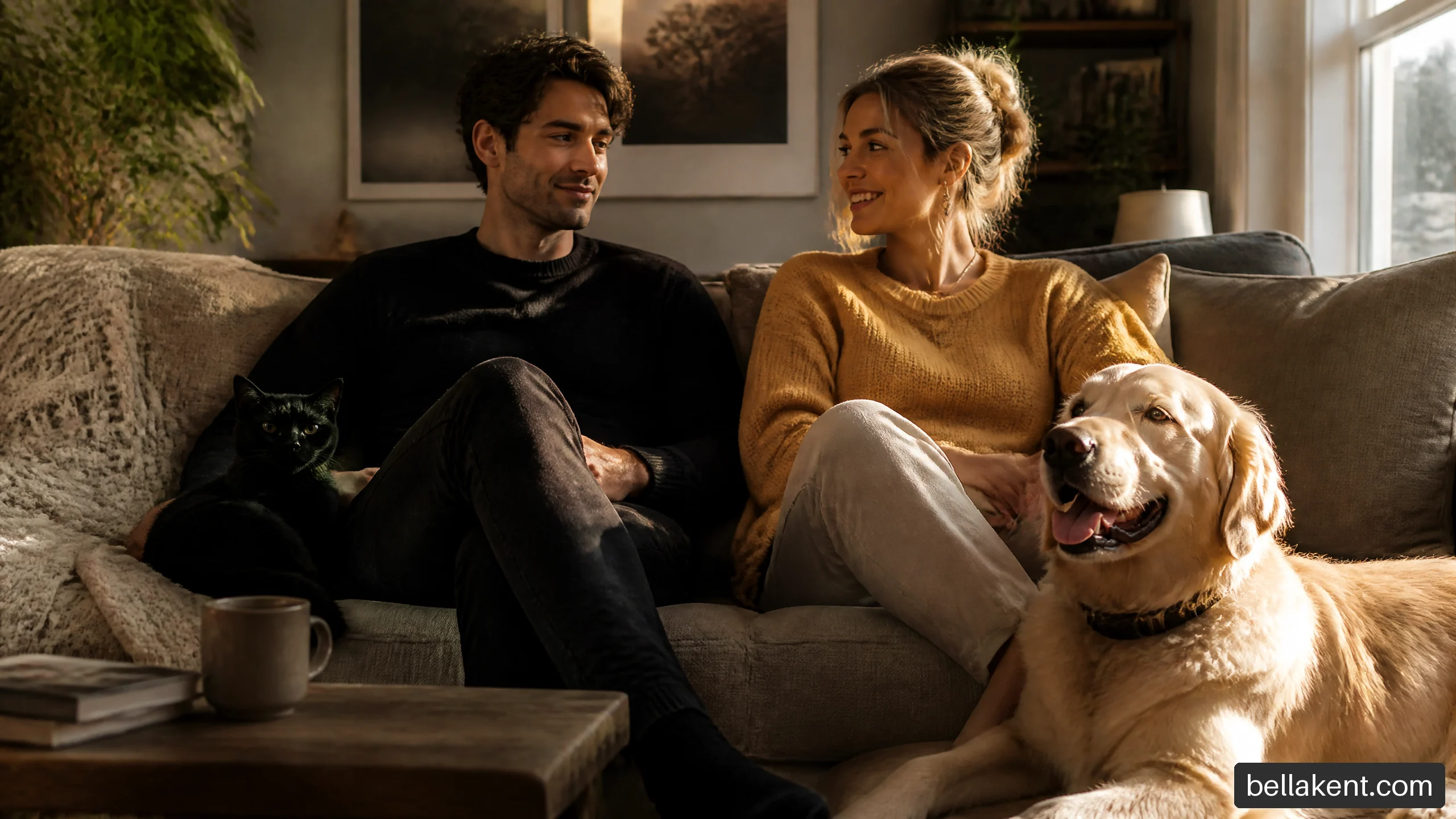
Black Cat Girlfriend Golden Retriever Boyfriend: The Internet Made It Viral. Here’s What It Means in Real Relationships—but the meme is more useful as a conversation starter than as a diagnosis. It gives couples a charming little shorthand for difference: one person is reserved, dryly funny, and selective with affection; the other is openly delighted, loyal, and emotionally legible from across the room.
I understand the appeal. As someone who studies relationship dynamics and meme culture, I have watched people use pet personification to explain things that used to require three long voice notes and a minor argument. The labels can be affectionate identifiers. They can also become tiny cages if a couple starts treating them as destiny.
Table of Contents
What this article covers
- What people usually mean by the meme
- Why the pairing feels so recognizable online
- How to tell a complementary difference from a real mismatch
- What emotional labor and gender expectations have to do with it
- A practical fit check for actual couples
- Common questions worth asking before you adopt the label
A quick note on the lens I am using
I am treating this as digital folklore, not a clinical personality system. There is no validated “black cat” or “golden retriever” scorecard, and no viral label can tell you whether someone will show up during a hard season of life.
TL;DR
The useful part
The meme can name a real and often sweet contrast in affective display: one partner may be quieter and more private, while the other is visibly warm and enthusiastic. That contrast can work beautifully when both people feel respected and both contribute to the relationship.
The part to ignore
Do not use the meme to excuse emotional unavailability, relentless reassurance-seeking, unequal emotional labor, or bad conflict repair. Compatibility is built through consistency, respect, communication, and shared values—not whether your couple photos look like a cat-and-dog cartoon.
Key Takeaways
The meme describes a vibe, not a personality test
In its common form, the “black cat girlfriend” is framed as independent, observant, mysterious, witty, and sparing with overt affection. The “golden retriever boyfriend” is framed as affectionate, excitable, loyal, earnest, and eager to connect.
That is a story about style, not substance. A quiet partner can be deeply secure and devoted. An expressive partner can be wonderfully grounded. Or, fair warning, a quiet partner may be shutting down while an expressive partner may be demanding constant emotional access. Same aesthetic; wildly different relationship outcome.
Contrast works only when it creates safety
A healthy version of the archetype tends to include:
• The reserved partner expresses care in ways the other person can recognize.
• The openly affectionate partner respects “not right now” without sulking or punishing.
• Both partners initiate repair after conflict.
• Neither person is cast as the permanent emotional manager.
• The couple can discuss needs without hiding behind the joke.
The label should make you curious, not complacent
You know, couples often embody these archetypes in playful ways, and that play can genuinely strengthen a bond. It says, “I see your particular brand of weird, and I like it.” But a meme becomes unhelpful when it ends the conversation instead of beginning one.
What the Black Cat and Golden Retriever Meme Actually Means
The shorthand behind the animals
The black cat girlfriend/golden retriever boyfriend relationship meme compresses a familiar couple archetype into two instantly readable animals. One partner is imagined as composed and slightly elusive; the other as sunshine with a calendar reminder to text “thinking of you.”
Here’s the thing: the meme does not require a woman to be distant or a man to be bubbly. People use the labels across genders and orientations because the appeal is really about relational contrast. It is an internet-friendly way to say, “We love differently, but we recognize each other.”
| Meme label | Typical online portrayal | What to look for in real life | What it should not excuse |
|---|---|---|---|
| Black cat partner | Private, observant, independent, dry humor | Clear boundaries, steady care, honest communication | Withholding, contempt, disappearing during conflict |
| Golden retriever partner | Warm, enthusiastic, affectionate, loyal | Consistent bids for connection, generosity, emotional openness | Neediness, pressure, ignoring boundaries |
| Healthy pairing | Different styles that feel complementary | Mutual respect, repair, shared responsibility | One person doing all the adapting |
Why it feels more accurate than it really is
The meme works because people recognize themselves in broad, emotionally flattering categories. “Black cat” can sound more glamorous than “I need an hour alone after social events.” “Golden retriever” can sound cuter than “I text three times when I am anxious.” Internet virality thrives on that little bit of flattering ambiguity.
In my own household, I have seen the animal metaphor do what metaphors do best: illuminate one behavior while ignoring five others. My cat once spent an entire afternoon glaring at a new chair, then slept in it every day afterward. That does not make her mysterious. It makes her a cat with standards—and honestly, many people are the same.
Why the meme spread so quickly
This pairing gives people three things social media rewards:
• A visual contrast that is easy to recognize in photos and short videos.
• A sweet narrative of complementarity rather than competition.
• A low-stakes way to announce, “This is how our relationship feels from the inside.”
When I look at online culture closely, I see people reaching for couple archetypes because modern dating can feel strangely underexplained. A relationship may not have a clear label, future, or even agreed expectations—especially amid situationships in modern dating. The meme offers a ready-made story. That can feel comforting, even when the story is incomplete.
Why Opposites Can Feel So Magnetic
The attraction mechanism is often relief
Different styles can feel relieving. A more openly affectionate partner may make warmth obvious, reducing guesswork. A more reserved partner may bring steadiness, perspective, and room to breathe. Neither role is inherently superior.
Consider an illustrative couple: Maya hates performative romance but remembers every detail of her partner’s difficult work week. Jordan sends affectionate memes before breakfast and happily plans the weekend. Maya feels cared for because Jordan is expressive without being demanding. Jordan feels cared for because Maya’s reliability is unmistakable. Their styles differ; their message is the same.
That is complementarity at its best.
Chemistry is not the same as compatibility
The contrast becomes a problem when it produces chronic uncertainty rather than safety. A person who pursues closeness and a person who repeatedly retreats can feel intensely drawn to each other, but intensity is not proof of a good fit. Sometimes it is simply a very efficient anxiety machine.
| If the contrast feels like this | It is more likely a healthy difference | If the contrast feels like this | It may be a mismatch |
|---|---|---|---|
| “We have different rhythms, but we can talk about them.” | Yes | “I am always guessing whether they care.” | Possibly |
| “Their enthusiasm makes me feel loved.” | Yes | “I must perform excitement to keep the peace.” | No |
| “Their need for quiet is clear and respectful.” | Yes | “They disappear whenever feelings get serious.” | No |
| “We both apologize and reconnect.” | Yes | “One of us chases while the other avoids.” | No |
Watch what happens after the cute part
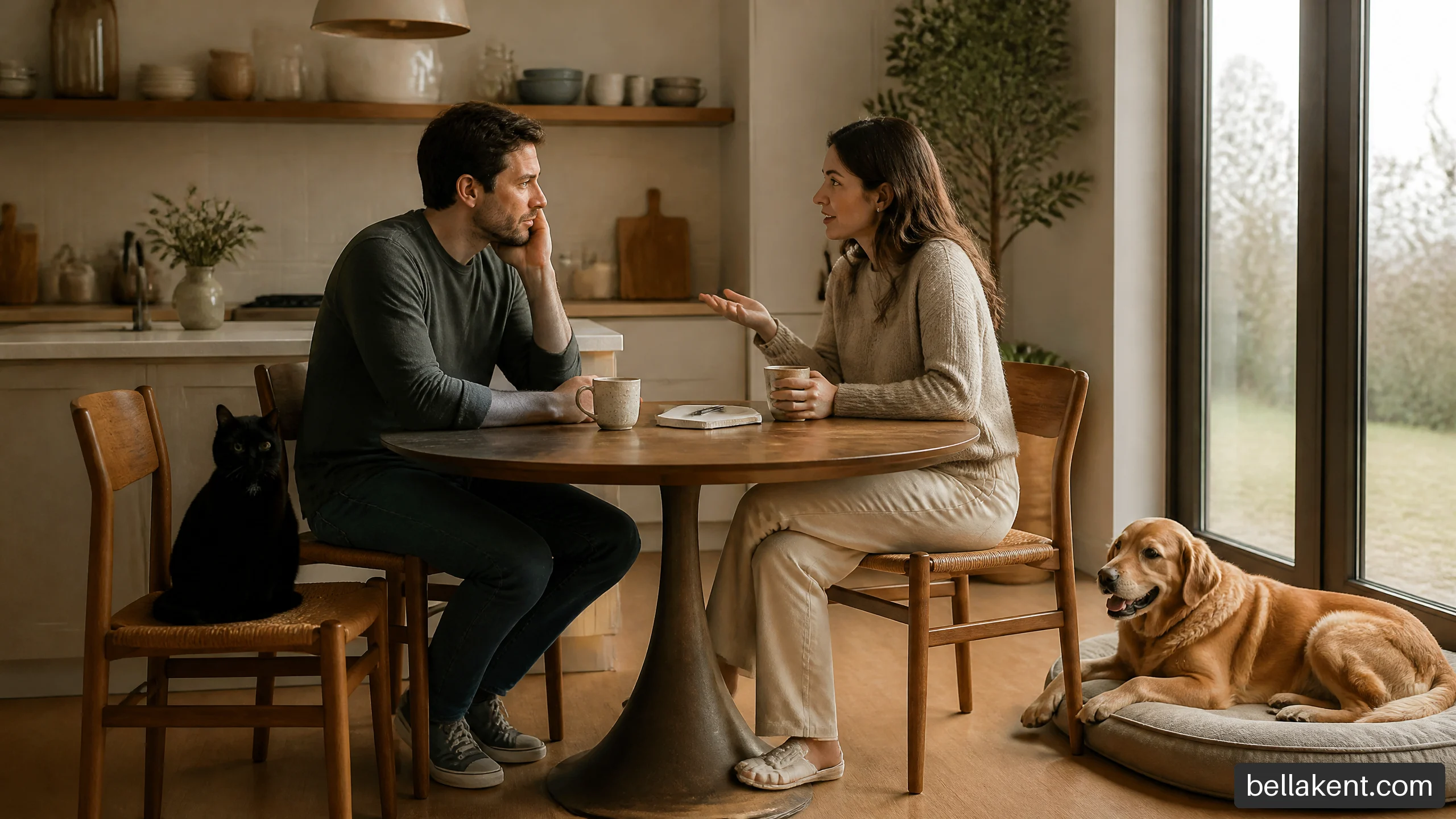
I would not assess this dynamic at brunch, during flirting, or in a comment section. Watch it after disappointment. Watch it when someone says no. Watch it when plans change at 6 p.m. and both people are tired.
A healthy “golden retriever” partner can hear, “I need quiet tonight,” and respond, “Of course. Want tea left at your door?” A healthy “black cat” partner can say, “I need quiet tonight, but I love you and I will call tomorrow.” Those sentences are not dramatic. That is precisely why they work.
Where the Meme Can Turn Into a Relationship Problem
When the joke assigns one person all the emotional labor
The biggest risk is not that one person is more openly affectionate. The risk is that the relationship quietly appoints one person as the full-time mood monitor, repair initiator, date planner, reassurance provider, and emotional translator.
A “golden retriever boyfriend” should not have to prove devotion by absorbing silence, mixed signals, or casual cruelty. A “black cat girlfriend” should not have to become endlessly available, bubbly, or physically affectionate on command. Emotional labor needs to move in both directions, even when the visible style is different.
Try this test: after a stressful week, can each partner name one concrete way the other makes connection easier? If only one person is doing the remembering, soothing, planning, and repairing, the meme may be disguising an imbalance.
When gender norms sneak in through the side door
The trend can look progressive because it celebrates an affectionate man and an independent woman. That is a welcome break from some stale scripts. Still, it can also repackage old expectations: women are “mysterious” when they withhold, men are “sweet” when they overfunction, and everybody is supposed to find it adorable.
I get a little skeptical here. Calling a woman cold for having boundaries is not sophisticated relationship analysis. Calling a man clingy for wanting basic reassurance is not either. The relevant question is whether each person can state needs, hear limits, and follow through—not whether their emotional expression fits a gendered animal costume.
When labels become self-fulfilling
Once a couple adopts the trope, they may begin performing it. The quiet partner stops initiating because “that is just my black cat energy.” The expressive partner overextends because “that is what golden retrievers do.” Soon, a playful identity becomes a script with no audition process.
If you want a little more rigor before turning a pattern into a conclusion, basic research guides on choosing a focused question and planning a research question offer a useful principle: define what you are actually observing. In relationship terms, replace “They are such a black cat” with “When upset, they ask for space and reliably return within a day.” Now you have something you can discuss.
A Real-World Fit Check for Couples
Start with behaviors, not aesthetics
When people ask whether their relationship “is” this meme, I suggest swapping identity labels for observable behaviors. This is less glamorous than matching Halloween costumes, but vastly more useful.
| Area | Useful question | Green flag answer | Concern worth discussing |
|---|---|---|---|
| Texting | Do we understand each other’s response pace? | “We communicate expectations.” | “I panic or punish when replies are slow.” |
| Affection | Can we receive care in different forms? | “We notice each other’s efforts.” | “Only one style counts as love.” |
| Conflict | What happens after someone gets overwhelmed? | “We take space and return to repair.” | “One disappears; one relentlessly pursues.” |
| Social energy | Can we honor different needs around people? | “We plan for both rest and connection.” | “One person is always dragged along.” |
| Responsibility | Who maintains the relationship? | “We both initiate, plan, and repair.” | “One person carries the invisible work.” |
Have the conversation the meme skips
Here are four questions I would ask over coffee, a walk, or while folding laundry—somewhere ordinary enough that nobody feels put on trial.
When do you feel most loved by me, specifically?
What does “needing space” look like in practice, and when will we reconnect?
What kind of reassurance feels supportive rather than suffocating?
After conflict, what is each of our responsibility for repair?
The point is not to make your relationship sound like a board meeting. It is to prevent each person from silently interpreting the other’s style. Many of the challenges in real-life interactions begin with that gap between what we mean and what another person can reasonably infer.
Know when to choose curiosity and when to choose a boundary
Choose curiosity when the difference is new, both people are trying, and the problem becomes smaller once you name it. For example, your partner may not realize that a two-word reply lands as rejection for you; a simple explanation and an agreed check-in may solve it.
Choose a firmer boundary when the pattern is repetitive, requests are mocked, or one person’s comfort consistently requires the other person’s self-erasure. If “I am just a black cat” is used to avoid accountability, the animal metaphor has overstayed its welcome.
FAQ: Black Cat Girlfriend and Golden Retriever Boyfriend
Is the meme about personality, behavior, or aesthetics?
Usually, all three—but mostly aesthetics and behavior. It is a social-media shorthand for how people seem to express warmth, independence, humor, and attachment. It is not a psychological assessment, attachment-style diagnosis, or reliable compatibility test.
Can opposite personalities make a good relationship?
Absolutely, if the differences are workable and reciprocal. One partner can be private while the other is expressive. One can love crowds while the other prefers a quiet dinner. The relationship works when neither person has to become someone else to be treated well.
Does the golden retriever partner usually do more emotional labor?
Sometimes the stereotype points in that direction, but it should never be assumed. The more outwardly affectionate person may be doing more visible relationship work, while the quieter partner may contribute in less visible ways. The key is whether both people initiate care, repair harm, and take responsibility for the emotional climate.
Is it a red flag if the meme feels uncomfortably accurate?
It can be a useful signal to look closer. If “black cat” means contempt, avoidance, or emotional disappearance, that is not a cute personality trait. If “golden retriever” means no boundaries, constant pursuit, or fear of displeasing a partner, that deserves attention too. The discomfort is not proof you must leave; it is a reason to have an honest conversation.
How can a reserved and openly affectionate couple communicate better?
Make care legible. The reserved partner can name affection instead of assuming it is obvious: “I need space, not distance from you.” The expressive partner can ask rather than chase: “Would you like comfort, quiet, or a check-in later?” Then agree on what reconnection looks like. That small bit of structure prevents a remarkable amount of unnecessary panic.
Is the trend harmless fun or does it reinforce stereotypes?
It can be both. In its healthiest form, it is shared humor and social signaling: a couple making a tiny private language public. In its worst form, it turns gender norms and unresolved problems into something people are expected to find charming. Use it if it makes both of you feel seen. Drop it if it makes one of you feel reduced.
Conclusion
Let the meme be a mirror, not a rulebook
The black cat girlfriend/golden retriever boyfriend meme taps into deeper relational archetypes that many people recognize—it is not just a joke. Still, the best relationships are not the ones that fit a viral caption. They are the ones where both people can be warm, private, silly, serious, needy, self-sufficient, and human without being punished for it.
If this label has helped you notice a pattern, great. Use that opening to talk about what actually sustains you both: reliability, repair, boundaries, shared effort, and affection that lands. For a fuller foundation, I would start with this guide to healthy relationships and intimacy.
Keep the joke; lose the script
A couple does not need matching archetypes to be compatible. They need a relationship where difference is met with curiosity, needs are met with respect, and no one has to beg to be understood. The internet can keep the animals. You two get to keep the nuance.
Sources and References
Research framing resources
Scope note
The sources above are general resources on researching and defining topics. They do not provide primary research validating this specific relationship meme, so the relationship interpretations in this article are presented as cultural analysis and practical guidance rather than clinical findings.