

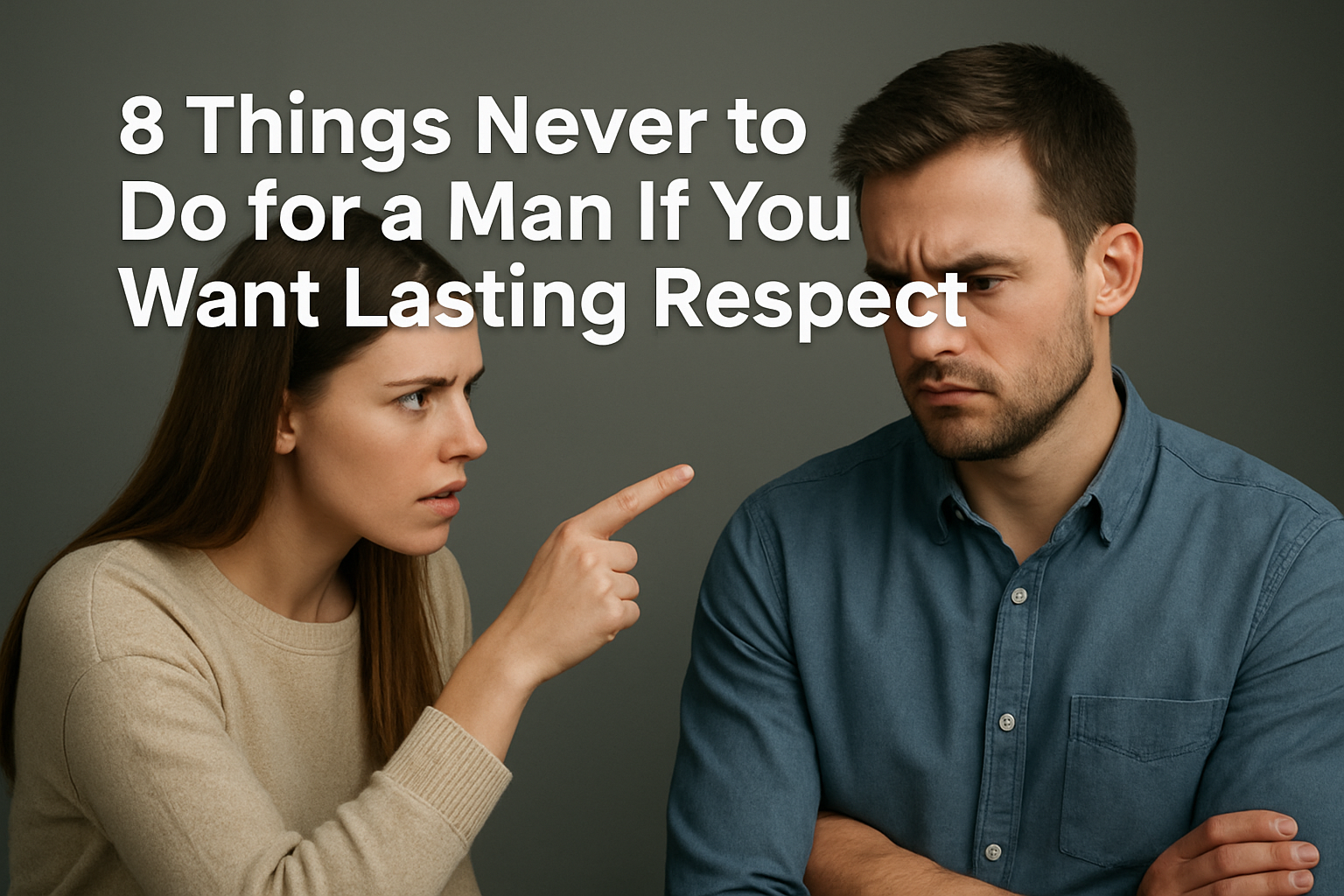
- Respect in a relationship relies on private, respectful communication, clear boundaries, and mutual interdependence rather than caretaking or public criticism.
- Avoid eight no-go behaviors: publicly undermining him, crossing or withholding boundaries, caretaking, weaponizing vulnerability, constant comparisons, ignoring his perspective, and sacrificing your principles to please him.
- Cultivate trust by addressing concerns privately, state boundaries with consequences, practice active listening, and foster equal participation in conflicts and decisions.
- Introduction
- 1. Publicly Undermining His Efforts
- 2. Withholding Boundaries or Blowing Through Them
- 3. Replacing Partnership with Caretaking
- 4. Weaponizing Vulnerability or Secrets
- 5. Constant Comparisons to Other Men
- 6. Ignoring His Perspective During Conflicts
- 7. Sacrificing Your Principles to Please Him
- FAQ
- Conclusion
- Describe the result you want and why it matters to you.
- Ask for collaboration instead of command. Use phrases like, “Can we try this together?”
- Pause for his perspective before proposing solutions.
- Agree on a small, measurable step with a clear check-in time.
- Start with a calm, specific statement of the boundary and its why. For example, “I need us to discuss disagreements without shouting, because I can’t think clearly when voices rise.”
- Pair the boundary with a consequence you will enact if it’s crossed, and follow through. Consistency builds trust.
- Offer a practical path to compliance, not a policing routine. Propose steps and check-ins to monitor progress.
- Protect boundaries in all settings, not just when it’s convenient. Apply them to conversations, plans, and daily decisions.
- Define shared responsibilities that fit both strengths, with clear ownership.
- Practice joint problem solving instead of unilateral fixes. Invite his perspective before deciding.
- Set regular check-ins to renegotiate tasks as needs shift, preserving flexibility.
- Protect space for vulnerability. Acknowledge limits and invite collaboration rather than rescue.
- Set a neutral environment and a clear intention to understand, not score points.
- Practice reflective listening: restate what you heard before offering feedback.
- Agree on confidentiality rules for private discussions so trust stays intact.
- Redirect heat into concrete actions rather than personal attacks when issues arise.
- Identify one area where he excels and acknowledge it regularly.
- Offer concrete examples of when his approach helped you or the partnership.
- Encourage him to lean into his natural strengths in shared goals.
- Avoid drawing attention to past partners or unrelated men in conversations.
- Practice active listening: paraphrase what you heard before replying to confirm understanding.
- Allocate equal time for each perspective: ensure concerns are voiced without interruptions.
- Avoid labeling or blaming: focus on behaviors and impacts, not character judgments.
- Use a pause signal: breathe and resume after a brief break when emotions rise.
- Summarize next steps together: agree on concrete actions and owners to prevent ambiguity.
- Invite questions about your stance to ensure clarity and reduce misinterpretation.
- Clarify non-negotiables first: name the values you won’t bend and why they matter.
- Find compromises that honor both sides: seek solutions that maintain integrity while meeting practical needs.
- Communicate boundaries calmly and consistently: explain what you will and won’t do, with specific examples.
- Use values as a compass, not a verdict: frame decisions around shared principles rather than personal wins or losses.
- Revisit agreements as a team: check in on how well your choices reflect your ethics and mutual respect.
- Reinforce boundaries with calm, firm clarity. State what you need and why it matters.
- Practice equal voice during disagreements. Listen first, reflect, then respond.
- Build interdependence, not dependency. Share responsibilities while honoring each other’s strengths.
- Avoid weaponizing vulnerability. Create a safe space for honesty without coercion.
- Focus on your own non-negotiables. Stand firm without compromising ethics.
Table of Contents
Introduction
Respect acts as the current that keeps a partnership alive. It signals that you see each other as equal and worthy. When respect exists, trust, safety, and honest communication follow.
Many people describe respect as feeling seen in the core of who they are. It isn’t about grandeur or perfection; it’s about everyday dignity, tone, and boundaries that aren’t crossed.
How these 8 behaviors erode respect (and what to change)
The eight no-go behaviors quietly chip away at mutual regard. They blur boundaries, undermine trust, and make intimacy feel precarious.
What matters most is shifting from insecurity driven reactions to choices that honor both partners. Address concerns privately, uphold boundaries, and value interdependence to keep respect intact.
1. Publicly Undermining His Efforts
Why public critique damages trust
Public critique erodes a man’s sense of reliability. Calling him out in front of others signals that his private effort isn’t worthy of respect. This isn’t about airing concerns; it’s about undermining dignity in a setting where he should feel seen.
Trust fractures when you treat his attempts as performances to be judged. He may retreat or withdraw, choosing silence over exposure. Over time, that pattern teaches you both not to share goals or vulnerabilities.
Constructive ways to address concerns privately
Keep critiques private, specific, and actionable. Focus on outcomes, not personality.
Private conversations preserve dignity, invite participation, and reinforce mutual respect. When concerns stay between you two, you maintain space for trust to grow rather than fracture.
2. Withholding Boundaries or Blowing Through Them
The role of boundaries in mutual respect
Boundaries define what you will and won’t tolerate. When you hold them, you signal that your needs deserve consideration and that you value yourself as a partner. Without edges, respect becomes negotiable and your voice gets diluted.
Healthy boundaries aren’t about punishment. They’re about clarity, consistency, and safety. They create a framework where both people can show up honestly without scrambling to guess what’s acceptable.
How to state and enforce healthy limits
Boundaries kept firm but fair reinforce respect. They reduce friction by making expectations explicit, so both partners know where the line is and how to stay on the right side of it.
3. Replacing Partnership with Caretaking
Why taking over solves nothing long-term
Caretaking undercuts a partner’s agency and slows mutual growth. It may feel efficient in the moment, but it erodes a core dynamic that relies on both people contributing. Over time, dependence can breed resentment and a quiet imbalance.
Relying on you to fix everything can mask your own insecurity within the relationship. When you stop offering support on demand, the gaps reappear as friction. Respect falters when one person shoulders the workload and emotional labor alone.
Fostering interdependence while maintaining trust
Interdependence means relying on each other in meaningful ways while keeping boundaries intact. It builds dignity, trust, and a sense that you’re navigating life together, not one person carrying the load.
4. Weaponizing Vulnerability or Secrets
How leveraging what he shared harms intimacy
Vulnerability is the entry point to trust. When you weaponize what he confided, you turn that trust into leverage. The result is a chilling effect: he stops sharing, and you lose candid moments that strengthen connection.
Using secrets as a signal that closeness is conditional creates guarded behavior, reduced candor, and distance you both will notice in daily interactions.
Creating a safe space for honest conversation
A safe space invites genuine honesty. When conversations stay respectful and private, you preserve the dignity that sustains respect over time.
5. Constant Comparisons to Other Men
Why comparisons erode identity and respect
Comparing him to others sends the message that his efforts aren’t enough. It undercuts his sense of self and signals you value an external standard more than the person in front of you. Over time, this breeds defensiveness, silence, and distance.
When you benchmark him against vague ideals or past romances, you ignore the real path you both are on. That distraction chips away at trust and makes him wonder where his place is in the relationship.
Building confidence through unique value
Shift the focus from what he lacks to what he uniquely brings. Celebrate specific, tangible strengths he demonstrates in daily life, decisions, and support.
By valuing his distinct contributions, you reinforce a personal sense of dignity. That clarity fuels mutual respect and deeper emotional connection.
6. Ignoring His Perspective During Conflicts
The impact of dismissal on respect
Disregarding his viewpoint during a dispute signals that his thoughts matter less. This can erode trust and chip away at the foundation of mutual respect. When one side feels unheard, conversations drift toward defensiveness rather than problem solving.
Repeated dismissal trains him to withhold input, weakening emotional intimacy and making healthy disagreement feel impossible. Respect rests on both partners feeling seen, even when opinions diverge.
Practical techniques for fair argument and listening
Fair argument strengthens trust because both voices shape the outcome. Listen with intention and respond thoughtfully, and respect remains intact even amid disagreement.
7. Sacrificing Your Principles to Please Him
The danger of compromising core values
When you bend your ethics to keep someone happy, you hollow out your sense of self. Compromising what you believe in signals that your core identity isn’t strong enough to stand on its own. Over time, this can erode respect because he may sense you’re not fully aligned with your own truth.
Ways to align needs without sacrificing ethics
FAQ
What does respect look like in everyday actions?
Respect shows up in consistent, fair behavior. It means speaking considerately, honoring commitments, and protecting each other’s boundaries. You’ll notice respect when both partners feel seen, heard, and trusted to contribute to decisions.
How can I rebuild respect after a breach?
Start with clear boundaries and honest dialogue. Acknowledge the impact, outline concrete changes, and follow through with steady behavior over time. Mutual accountability matters for restoring trust.
When is it healthier to walk away?
If repeated breaches threaten core safety, dignity, or values, or if repair efforts leave you feeling diminished, stepping away can protect your well being. Respect is earned through reciprocal, non negotiable standards.
Conclusion
Summary of the eight no-go behaviors
The eight patterns quietly erode lasting respect. Public undermining damages trust, while unclear or breached boundaries threaten safety. When partnership shifts into caretaking, or vulnerability is weaponized, the emotional balance tilts away from mutual regard. Constant comparisons to other men undermine identity and the shared sense of value. Dismissing a partner’s perspective during conflict slows resolution, and sacrificing core principles to please him erodes ethics and self-trust. These behaviors signal a misalignment with dignity and mutual regard.
Next steps for cultivating lasting respect
References
- 7 Things That Quietly Kill a Man’s Respect for You – YouTube
- 7 things you should never do to a man, especially if you want respect …
- The 5 Things Every Man Needs to Feel Respected in a Relationship
- 4 things you should never tell a man if not, he’ll never respect you #usa …
- What are things you should never do to please your partner? – Quora